Revelstoke in Winter: North America’s Longest Descent, Four and a Half Hours from Calgary
The biggest vertical on the continent, ten metres of snow a year, heli and cat skiing on the doorstep, and Rogers Pass in between. How to plan a Revelstoke ski trip from Calgary.
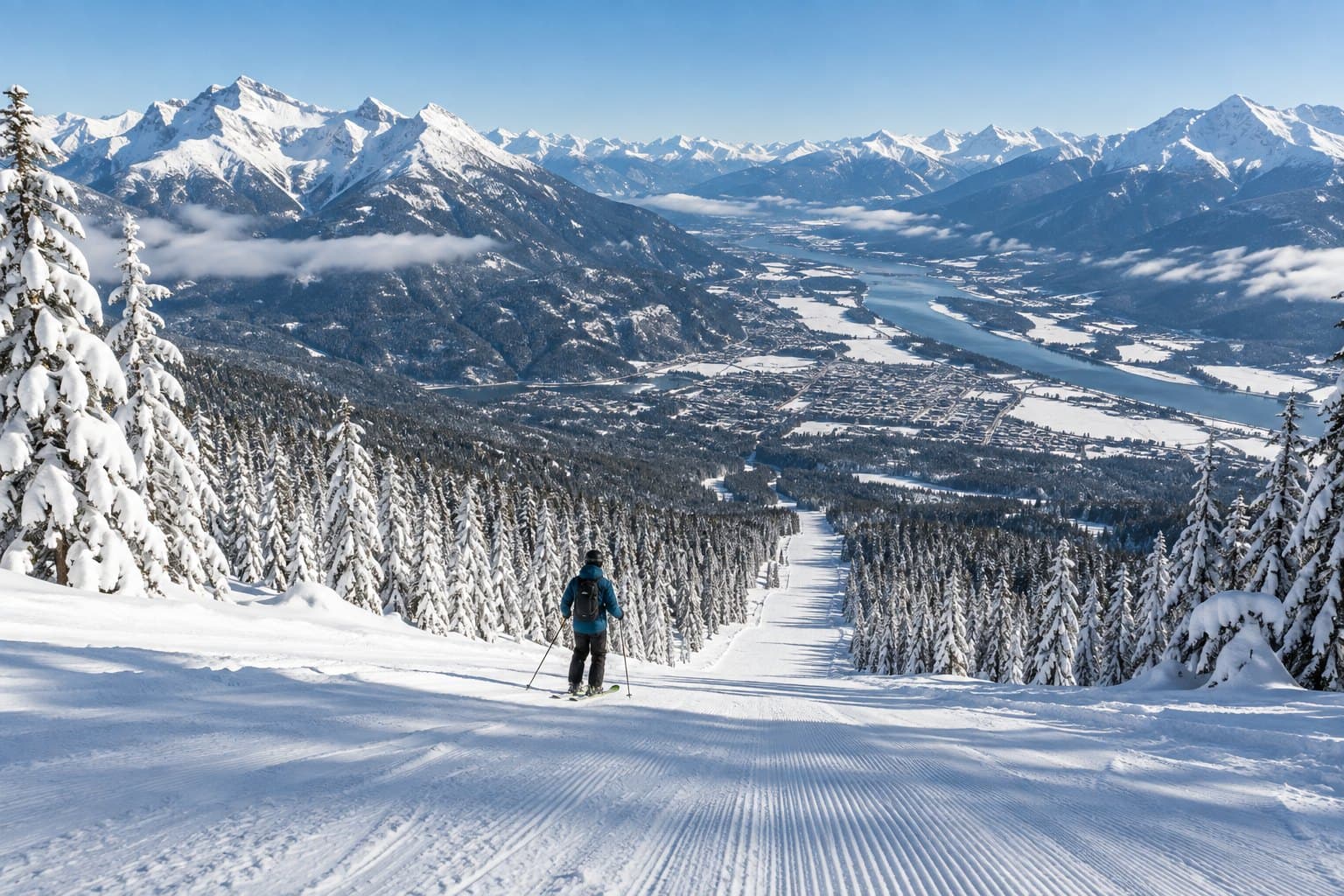
Revelstoke is where Calgary skiers go when the Bow Valley stops being enough. It sits about 410 km west of Calgary International Airport, on the far side of the Rockies and the Selkirks. It has the longest ski descent in North America, and more snow than almost anywhere you can drive to. It is also on the other side of Rogers Pass, which is the part of the trip worth planning properly.
The mountain
Revelstoke Mountain Resort has 1,713 metres of vertical descent, about 5,620 feet. The resort bills it as the longest descent in North America. The Revelation Gondola alone climbs 1,170 m, and the Stoke Chair takes you above it.
- 3,121 skiable acres across 75 runs, in four bowls: South, North, Separate Reality and Greely.
- An average of 10.5 metres of snow a year.
- The Last Spike, the longest run, is 15.2 km from top to bottom.
- The terrain leans hard: 45% of it is rated advanced and only 12% beginner.
That last number is the honest answer to "is it for us?". Strong intermediates and experts will not run out of mountain in a week. A family of first-timers will be happier at Sunshine or Lake Louise and can save Revelstoke for when they are ready for it.
The 2026/27 season
The resort opens on Saturday 5 December 2026. The closing date for 2026/27 has not been announced. Last season closed on 12 April, and the resort says it stays open through the Easter weekend.
Revelstoke is on the Ikon Pass:
- Ikon Pass: up to seven days with no blackouts.
- Ikon Base Pass: up to five days. It is blacked out from 26 to 30 December 2026, on 16 and 17 January 2027, and on 13 and 14 February 2027.
- Mountain Collective: two days, with no blackouts.
Those blackout dates are also a fair map of when the mountain is at its busiest.
Beyond the resort
Heli-skiing is what made Revelstoke's name, and it still has more operators than most whole regions. Tourism Revelstoke lists Eagle Pass Heli, Selkirk Tangiers, CMH Revelstoke, Mica Heli-Skiing and Kingfisher Heli-Skiing.
Cat-skiing: K3 Cat Skiing runs from town. Great Northern Snowcat (Trout Lake), Mustang Powder (Malakwa) and Monashee Powder operate further afield in the region.
Rogers Pass in Glacier National Park is serious ski-touring terrain, and it is managed as such:
- Zones: the park is divided into prohibited, restricted and unrestricted areas. The restricted areas open or close day by day around the avalanche control programme.
- Permits: you need a winter permit (annual online, or daily from Summit Station, both with a quiz) and a park pass.
- Forecast: check Avalanche Canada before you go. The fines for entering a closed area are steep.
Nordic skiing: the Revelstoke Nordic Ski Club grooms trails at Mount Macpherson, about 7 km south of town, including a lit loop for evenings.
Snowmobiling: the local club grooms riding areas on Boulder Mountain and Frisby Ridge.
Halcyon Hot Springs is the soak worth the drive: about 68 km south, including a short free ferry across Upper Arrow Lake. Canyon Hot Springs, east of town, is closed in winter.
Downtown: evenings end up around Grizzly Plaza on Mackenzie Avenue, with the maples lit through the winter. In February the town holds its Winter Carnival, with the 2027 dates still to be announced.
The drive, and what catches people out
The route is the Trans-Canada all the way: Banff, Lake Louise, over Kicking Horse Pass to Golden, then over Rogers Pass to Revelstoke. In good conditions it takes about four and a half hours.
The clock goes back an hour. Glacier National Park and Revelstoke are on Pacific time, and Golden is on Mountain time. Westbound you gain an hour, and on the way home you lose it. Hotel check-ins and lift times are all local.
Rogers Pass closes for avalanche control. Parks Canada and the Canadian Armed Forces run the largest mobile avalanche control programme in the world here, across 135 avalanche paths on 40 km of highway:
- How long: closures usually last between two and eight hours, sometimes longer, and traffic is held in the towns on either side. In March 2026 the highway was closed on and off for four days.
- No detour: there is no practical way around, so the realistic plan is to build in slack and check before you set off.
Stopping is restricted on the pass. There are no-stopping zones under the avalanche paths, and most pull-outs are closed from November to April. Leave with a full tank and something to eat.
British Columbia requires winter tires. On this highway they are required from 1 October to 30 April: three-peak mountain and snowflake, or M+S, with at least 3.5 mm of tread. Alberta does not require them, which is exactly why people get caught.
Check DriveBC the morning you leave. Check Alberta 511 for the Alberta half.
The Kicking Horse Canyon east of Golden, for years the slowest part of the drive, has been a four-lane divided highway since late 2023.
When to go
- January: cold, stable and deep, and many regulars' favourite month.
- February: a mix of storm days and bluebird days.
- December: quieter, once the resort has enough base.
- April: the soft, sunny end of the season.
The Christmas week and the long weekends in January and February are the busiest.
Getting around once you are there
The resort's main parking lot is high-occupancy only this season: two or more people per vehicle. A shuttle runs between downtown and the base about every 15 minutes, from 6:15 am to 8:30 pm, for $2. Being dropped at the door avoids the question entirely.
Revelstoke has no scheduled commercial flights. The nearest alternative airport is Kelowna, about 187 km and two and a half hours away.
With a chauffeur
A Revelstoke trip is two long mountain drives with a ski week in between, and the drives are where the risk is. We run private, fixed-fare transfers from Calgary and YYC to Revelstoke:
- The vehicle: a winter-tired SUV with room for skis and boards, and a chauffeur who drives the Trans-Canada every week.
- The pass: we watch DriveBC and the Rogers Pass closures so you don't have to. If the pass is shut, you hear from us before you leave, not from a sign at the Golden turn-off.
- The way home: choose Return when you book and pick your ride back to Calgary in the same booking, up to 7 days after your drop-off. British Columbia's rules let us bring you home within that week.
Going somewhere in this story?
Fixed rates, a professional chauffeur and a car that fits the weather. Tell us the date and we will quote it.
Book Transfer.Keep reading
Winter Driving on Alberta Mountain Highways: What Actually Matters
Winter tires, black ice, the Lac des Arcs wind gap and what to keep in the car. The practical guide to Highway 1 and Highway 93 between November and April.
Read the post
Every Ski Resort Within Reach of Calgary, Compared
Sunshine, Lake Louise, Norquay, Nakiska, Castle and Marmot Basin. Drive times, terrain, who each one suits and what the day actually costs.
Read the post
Winter Festivals in Banff and Lake Louise, Month by Month
Christmas markets in November, ice carving in January, SnowDays in the same month. What is on in the Bow Valley between November and March, and what is worth planning around.
Read the post